Micro, Small, Medium or Large? How Your Company Size Determines KVK Filing Requirements in the Netherlands
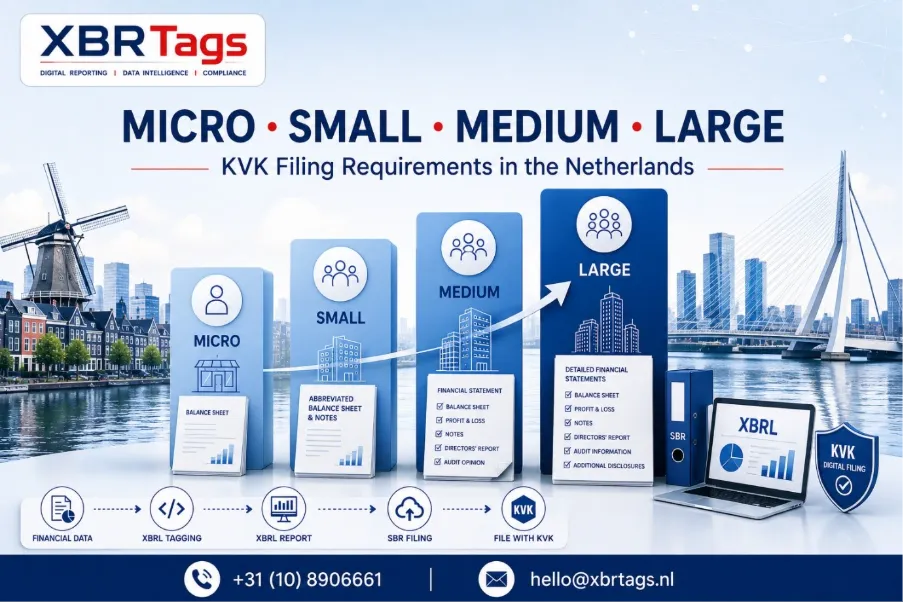
For businesses in the Netherlands, filing financial statements with the Netherlands Kamer van Koophandel (KVK) is an important part of staying compliant. There is no single reporting format that applies to every company.
Your company size determines how much financial information you need to prepare and file. A small business may only need to submit a limited balance sheet, while a larger company may need to provide a more detailed set of financial statements including a profit and loss account, directors' report, notes and audit information.
This is why knowing whether your company is micro, small, medium-sized or large matters. It can affect your reporting workload, the information included in your accounts, the filing process and the type of digital reporting you need to use. For businesses preparing their KVK accounts in 2026, understanding these categories is especially important because digital filing through Standard Business Reporting (SBR) now covers large legal entities as well.
Who Has to File Annual Accounts with KVK?
Not every business in the Netherlands has to file financial statements. Legal entities such as BVs, NVs, cooperatives and mutual insurance associations generally have a filing obligation. Certain partnerships with partners and some associations and foundations can also fall under the rules. A sole proprietorship or eenmanszaak generally does not have to file accounts with KVK.
If your organisation does have a filing obligation, the next question is: what size category does it fall into?
KVK divides companies into four categories:
- Micro
- Small
- Medium-sized
- Large
The larger the company, the more detailed its financial reporting requirements become.
How Does KVK Determine Company Size?
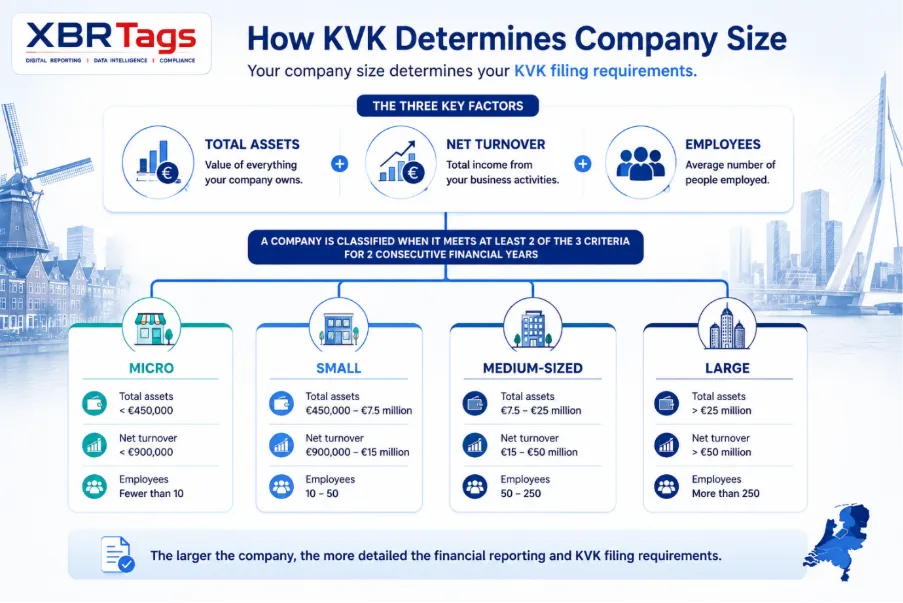
KVK looks at three factors:
- Total assets
- Net turnover
- Number of employees
A company normally falls into a category when it meets at least two of the three criteria for two consecutive financial years.
Here is the basic classification used by KVK:
| Company size | Total assets | Net turnover | Employees |
|---|---|---|---|
| Micro | Less than €450,000 | Less than €900,000 | Fewer than 10 |
| Small | €450,000 – €7.5 million | €900,000 – €15 million | 10 – 50 |
| Medium-sized | €7.5 – €25 million | €15 – €50 million | 50 – 250 |
| Large | More than €25 million | More than €50 million | More than 250 |
These figures are based on KVK's current business-classification guidance.
Micro Companies: The Simplest KVK Filing
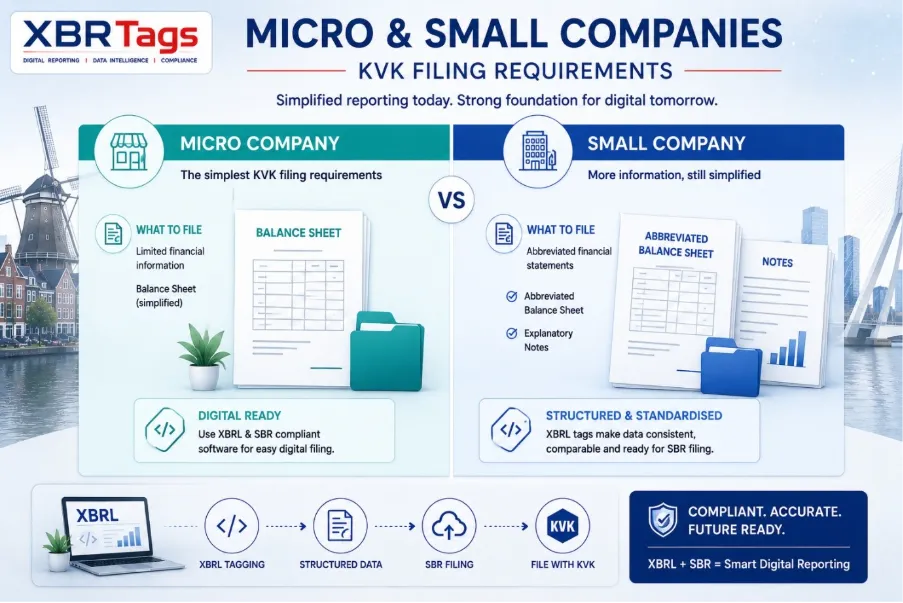
Micro companies have the lightest reporting requirements. For this category the financial statements generally include a balance sheet. The amount of information made publicly available is therefore more limited than for larger businesses. That does not mean the filing can be treated casually — the figures still need to be accurate, complete and prepared according to the accounting requirements. For a company, using accounting software that supports SBR and XBRL can make the filing process much easier.
Small Companies: Information, Still Simplified
Small companies have more reporting requirements than micro companies, but they can still benefit from simplified reporting. Their filed financial statements generally include an abbreviated balance sheet and explanatory notes.
This is where businesses often start to notice the value of digital reporting. Instead of manually preparing information for different systems, XBRL allows financial data to be structured using standard reporting concepts. SBR then provides the reporting framework used to submit that information. For businesses using XBRTags, proper tagging can help make financial information more structured, consistent and ready for reporting workflows.
Medium-Sized Companies: Reporting Becomes More Detailed
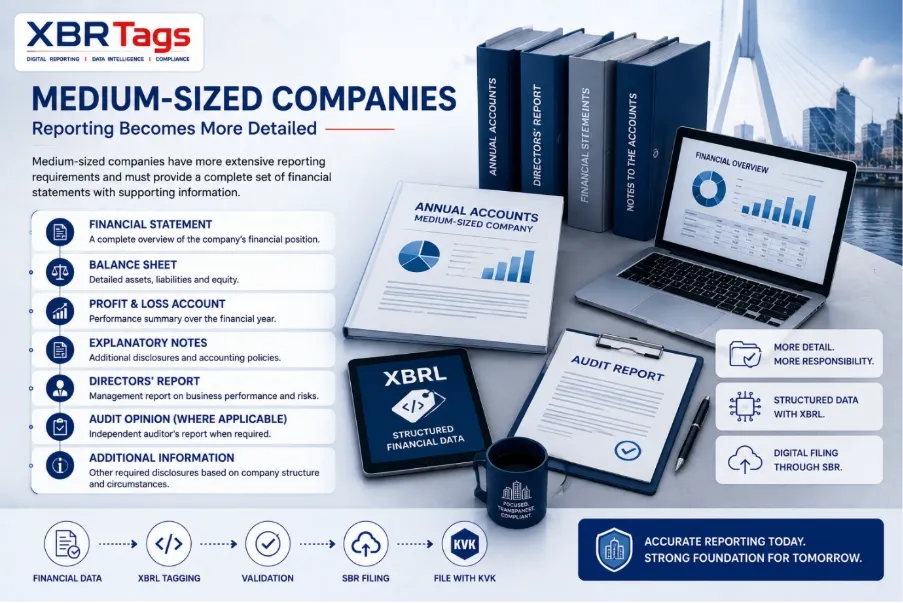
Once a business enters the medium-sized category, the reporting requirements become more extensive. A medium-sized company generally needs to provide:
- A financial statement
- A balance sheet
- A profit and loss account
- Explanatory notes
- A directors' report
- Relevant additional information
- An audit opinion, where applicable
The exact filing requirements depend on the company's structure and circumstances. At this stage, financial reporting is no longer about putting numbers into a basic annual account. Companies need to pay attention to data accuracy, reporting concepts, disclosures, consolidation requirements and digital filing formats. This makes a reliable XBRL preparation and validation process increasingly valuable.
Large Companies: The Highest Reporting Burden
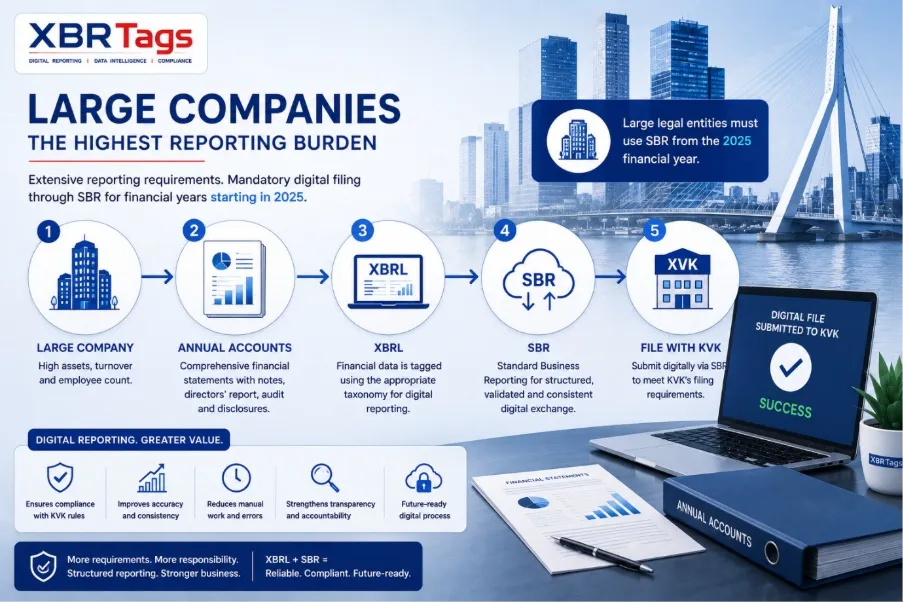
Large companies have the most extensive reporting requirements. Their annual financial statements can include a balance sheet, detailed profit and loss account, explanatory notes, directors' report, audit information and other required disclosures.
Large companies also face a digital filing change. For the 2025 financial year, large legal entities became subject to digital filing through SBR. KVK states that large companies must use SBR from the 2025 financial year, bringing them into the same broader digital reporting framework already used by smaller categories. For companies preparing their accounts in 2026, this makes XBRL-ready financial reporting more important than ever.
Does Company Size Affect XBRL Filing?
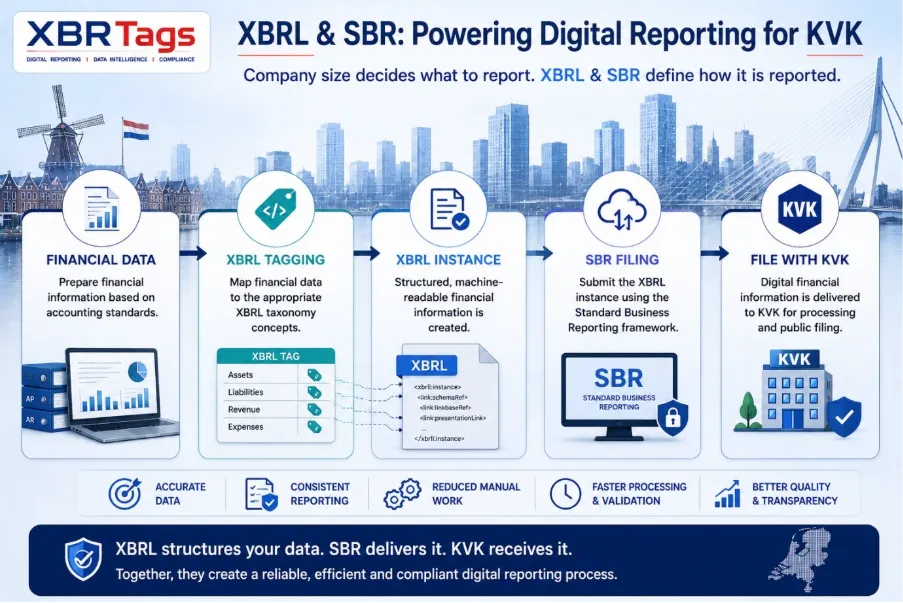
Yes. Company size affects the content and level of detail of the statements, while XBRL provides the structured digital format used to communicate financial information. Micro, small and medium-sized legal entities have already been required to file digitally in XBRL through SBR or the relevant KVK filing route. Large legal entities are now included in SBR filing from the 2025 financial year.
In short: company size determines what you need to report. XBRL helps determine how that information is structured for reporting. This distinction is important when planning your accounts.
What Is SBR, and Why Does It Matter?
Standard Business Reporting (SBR) is the reporting framework used in the Netherlands. Rather than sending financial information in an unstructured format, SBR uses standardised digital data so information can be exchanged with government and other organisations in a consistent way. XBRL is a technology behind this process.
For companies this can reduce data entry and make financial information easier to process. However, digital filing does not remove the company's responsibility for the information — it remains responsible for the content and timely submission of its statements.
When Do You Need to File Your Annual Accounts?
The filing deadline depends on the structure of the business and when the annual accounts are adopted. One important rule is that once the annual accounts have been adopted, they generally need to be filed with KVK within eight days. In all cases, the accounts must be on file within the statutory period, which is 12 months after the end of the financial year.
For a Dutch BV, for example, the board normally prepares the accounts within five months after the end of the financial year and presents them to the shareholders. Missing the deadline can have consequences, including potential fines and, in certain circumstances, personal liability for directors if the company later becomes insolvent.
Common KVK Filing Mistakes to Avoid
Using the Wrong Company Category
A company may continue using the reporting requirements from a previous year without checking whether its size classification has changed. Review the three size criteria each year.
Missing Required Disclosures
As companies grow, their reporting requirements become more detailed. Leaving out required notes or supporting information can create compliance problems.
Treating XBRL as Just a File Format
XBRL is more than converting a document into another file type. Financial data needs to be mapped to the appropriate concepts and reporting taxonomy.
Filing Late
Even a technically correct annual account can create problems if it is submitted after the applicable deadline. Build the KVK filing deadline into your financial reporting calendar.
Assuming Bigger Always Means More Reporting Is Better
More financial information is not automatically better if it is incorrectly prepared or tagged. The goal should be complete, consistent and compliant reporting.
How XBRTags Can Help with KVK Reporting
Preparing accounts for digital filing can become complicated as your company grows. Different company sizes require different levels of information, while XBRL reporting requires financial data to be mapped accurately to the relevant taxonomy concepts. XBRTags.nl can support businesses and professionals working with XBRL and digital financial reporting by helping turn financial information into structured, reporting-ready data.
A good XBRL workflow can help you:
- Organise information
- Apply appropriate XBRL tags
- Reduce manual reporting work
- Improve consistency
- Prepare data for SBR-based filing
- Identify potential tagging issues before submission
The important point is that technology should support the reporting process, not replace review.
Conclusion
Your company size is more than a number on a business profile. It can directly influence what you need to report to KVK and how detailed your annual accounts need to be. Micro companies have the lightest reporting requirements, while small and medium-sized companies face progressively more detailed obligations.
Large companies have the most extensive reporting requirements and are now also subject to mandatory digital SBR filing for the 2025 financial year onward. As digital reporting becomes standard in the Netherlands, understanding KVK filing requirements, XBRL, SBR and company-size classifications is essential for staying compliant.
If you are working on accounts for KVK, the first thing you need to do is simple: figure out what type of company you have, know exactly what details you must share, and make sure your financial numbers are properly set up for digital submission. Using the XBRL process, companies can make the reporting process more accurate, easier and simpler — no matter if they are micro, small, medium or large.
Frequently asked questions
The size of the company decides how much financial information you must include in your annual accounts. Micro companies have lighter rules, while medium and large companies usually need to give more detailed information.
Companies in the Netherlands are usually split into micro, small, medium-sized or large. The way they are grouped depends on things like assets, net sales and the number of people they employ.
If the company is an entity that must file, it usually has to submit annual accounts with KVK. Small companies often get simpler reporting rules than bigger companies.
Digital filing rules depend on the kind and size of the entity. XBRL and SBR are important in the reporting process, with large legal entities also needing to use SBR for financial years starting in 2025.
Standard Business Reporting (SBR) is the system for sharing financial information digitally. It uses formats with XBRL helping to structure financial details for digital reporting.
Filing late can cause problems with following the rules. In some cases it can lead to money fines or responsibility for the directors if the company goes bankrupt. That is why it is important to know when you need to file and do it on time.
Yes. XBRL software can help arrange data, use the right labels and get the information ready for digital submission. The correct process can cut down on work and help find mistakes before you file.
Make KVK Reporting Easier with XBRTags
Preparing annual accounts for KVK does not have to be a complicated process. With the right XBRL workflow, you can structure your financial data, improve reporting accuracy, and prepare your accounts for digital filing with greater confidence.